Sunday, August 19, 2018

The 5 Rules of
Gaining Muscle Mass

(Pack on the Pounds)

We’ve compiled a list of the 5 most important nutrition rules to help you get the best gains from your workouts. Here they are in order of importance.

Whenever you start anything new, there’s always a learning curve and you’re bound to make a few rookie errors along the way. In bodybuilding there are two main mistakes beginners tend to make

Following a training program that’s not appropriate for their goals

Underestimating the importance of nutrition

You don’t grow just because you train; growth is actually dependent on proper recovery from training. And the way you recuperate best is by providing your body with the nutrients it needs at the appropriate times for optimal recovery and growth. Your goal is to add lean mass — muscle tissue. That’s true whether you’re a hardgainer, a guy with good genetics or a guy who carries excess bodyfat. Here are the basic nutritional principles you need to support your training to maximize your chances for muscle growth right out of the gate

Make sure you consume adequate calories every day

The bottom line is you can’t add weight if you aren’t taking in more calories than you’re burning. If you’re trying to pack on muscle, you have to consume enough surplus calories to support that growth. If you’re heftier to begin with, this task is a little trickier. You need to get enough calories to add muscle mass, but you also want to avoid an excessive increase in bodyfat. While you’re adding muscle mass, you should regard maintaining or just slightly increasing your bodyweight as progress
Split your total calories fairly evenly over 5–6 meals per day
This recommendation is a bodybuilding standard. The more frequently you feed your body, the better the contribution you’re making to build muscle mass while at the same time avoiding the addition of bodyfat. If you consume 3,000–4,000 calories over six meals versus just three meals, your metabolism will stay elevated and you’ll gain more muscle and much less bodyfat. Those who consume the same number of total calories, but in fewer, larger meals, however, send their bodies the signal to store bodyfat.

Take in at least 1 gram of protein per pound of bodyweight each day

When you want to build muscle tissue, you have to provide your body with the amino acids it needs. These aminos (there are 22 in total, essential, nonessential and conditionally essential) come from protein foods and protein supplements. Eating a variety of different protein sources is the best way to make sure you get a broad range of aminos. By targeting at least 1 gram of protein per pound of bodyweight, split fairly evenly over your six meals, you’ll keep a steady flow of aminos in your bloodstream to fuel growth

Eat plenty of fruits and vegetables

Many beginners focus too much on protein or calories at the expense of other types of foods that are dense in nutrients per calorie. Make sure you get in at least six servings of vegetables and fruit each day. They’re low in calories but rich in vitamins and minerals to support gains and overall health. At larger meals, you should consume more than one serving and you can do your body an even bigger favor by having a few different fruit or veggie items on your plate

Emphasize workout-window nutrition
 
Around the time of your workouts — before and after — your body needs protein and fast-digesting carbs (sugar) to drive the recovery process. Consuming sugar before and after your workouts helps reload glycogen burned during exercise, and it delivers amino acids to your muscles so that they recover and grow more quickly. Take in about 25–40 grams of protein before and after your workouts, depending on your bodyweight. Hardgainers should match their sugar intake to their protein consumption, gram per gram, pre- and post-workout. If you’re a bigger guy starting out, you can cut the sugar before workouts and just take it after.

Thanks with your success!
Sunday, August 12, 2018

The Meanest Mean-Ass Arm Workout Yet

Yep, that's right: Double mean. Between the volume, the supersets, the dropsets, and the BFR, latest arm workout will have you skipping the silverware and eating your meals right off the plate.

If Abel Albonetti says this is the meanest workout he's ever done, you'd better be prepared for a serious smackdown. A MuscleTech-sponsored athlete and Team Bodybuilding.com member, Albonetti is known for his hardcore workouts, and this arm blast doesn't disappoint.
During a workout that had Albonetti himself groaning in pain during filming, you'll be supersetting biceps exercises with triceps exercises in a way that quickly exhausts your arms. That's too bad, because it's going to be a very long workout.
All right, campers, cinch up your shorts and let's get to it.


Technique Tips

Seated Dumbbell Curl and Skullcrusher

Albonetti starts you off with 4 straight sets of dumbbell curls. Take each rep slow and easy with lots of good, long negatives. During the concentric portion of the lift, rotate your pinkies all the way in to get full rotation at the top of the exercise.

Seated Dumbbell Curl and Skullcrusher 
 
For the fifth and final set, drop the weight by half. As you do eight reps with one arm, keep the other arm in an isometric hold. Switch arms and repeat. Immediately do 7 more reps with one arm, keeping the other in an isometric hold, then switch arms and do 7 more. Continue decreasing the number of reps by 1 until only 1 remains. Do that rep with each arm to finish.
Follow the same rep plan for the skullcrushers. Hold the stretch at the bottom of the rep, keeping tension on your triceps.

Preacher Curl and Standing Dumbbell Triceps Extension

When you do the preacher curls, make sure you're not going all the way up and losing tension. Keep that bar constantly moving so your muscles are contracted the whole time. When you're doing the triceps extension, tuck in your elbows. Don't flare them out. Go all the way down to stretch out your triceps. As with the preacher curls, don't pause at the top. Keep going to maintain tension on your biceps and triceps the whole time.
On the last set, Albonetti tosses in a double dropset—for both exercises. Go to failure on these. You might not be able to do as many reps as you did at first, but push for at least 6 reps.

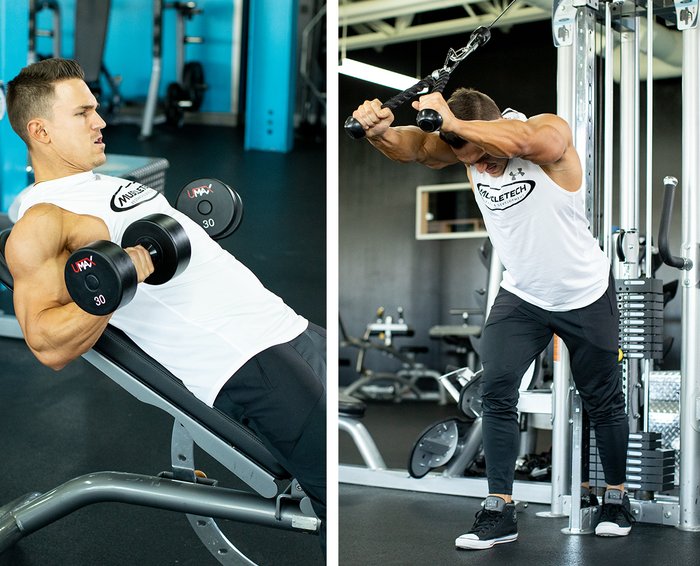
Incline Dumbbell Curl and Cable Rope Overhead Triceps Extension

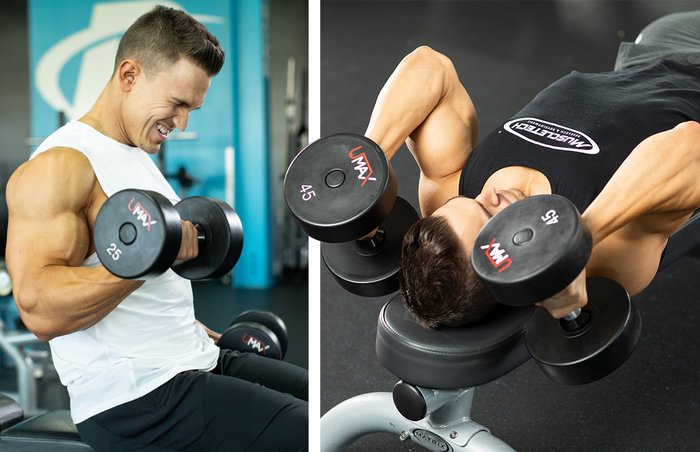
Go all the way down on the incline curls for a good biceps stretch. At the bottom, flex your triceps to stretch your biceps to the max. After you complete the twelfth rep of the fourth set, lower your arms all the way one more time and hold 30 seconds for a good stretch. Drop the weight by about 10 pounds, rep to failure, and lower the dumbbells for another 30-second stretch. Reduce the weight another 10 pounds, rep to failure, and repeat.

Incline Dumbbell Curl and Cable Rope Overhead Triceps Extension 
 
On the overhead extensions, let the rope go all the way back to fully stretch your triceps. After the twelfth rep in the fourth set, repeat the dropsets exactly as you did for the incline curls.         
According to Albonetti, if you can do 10 reps or more before failing in either of these final sets, add more weight the next time.

Barbell Curl 21s and Triceps Push-down 21s

Do the first seven barbell curls while standing up, moving the bar up from your thighs to parallel to your waist, then immediately sit down for the next seven curls. When you're sitting, you won't be able to lower the bar past your thighs. Once you've done seven of these reps, stand up again and do the last seven reps as full reps, moving the bar from your chest to your thighs for a total of 21 reps.
Stand for all the triceps push-downs. For the first seven reps, start with the rope at your waist and push down to your thighs. For the next seven, start with the rope at your shoulders and push down to your waist. For the final seven reps, do complete reps, moving the rope from your shoulders to your thighs for another total of 21 reps. On the rope push-downs, flare the rope ends as much as possible.


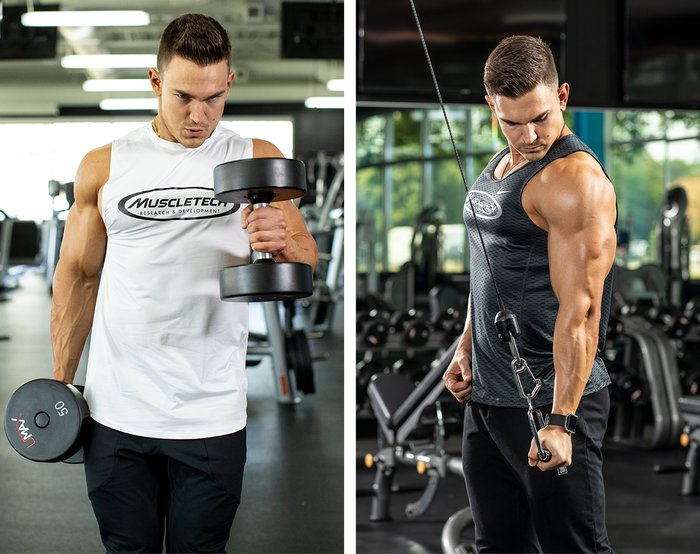
Hammer Curl and Cable Single-Arm Triceps Extension

Alternate your arms on the hammer curls to go as heavy as possible. When you're doing the triceps extensions, as the cable goes across your body, squeeze your triceps for a full contraction. At the bottom, squeeze your arm muscles for about half a second.

Hammer Curl and Cable Single-Arm Triceps Extension

Standing Biceps Cable Curl and Triceps Push-down

What better way to finish Albonetti's mean-ass workout than to strap on a pair of BFR straps? You'll achieve a huge pump and engorge your arms with nutrients and blood.
Position the BFR bands high up on your biceps. Wrap them with a tightness of 6-7 out of 10. Keep them in place for all 5 sets. As you do these BFR sets, rest 45 seconds between sets to create that extreme pump.
Albonetti recommends doing this workout once every two weeks. There's too much volume—and it's just too damn tough—to do it every week.

5 Signature Moves for a Crowded Gym

By learning these five variations on exercise mainstays, you'll stimulate your muscles in new ways and have more choices when there's lots of competition for equipment. 


Necessity, they say, is the mother of invention. For Bodybuilding.com Signature athlete Julian Smith, that was definitely the case. As Smith explained in The Bodybuilding.com Podcast, he was frustrated as a young lifter by training at busy gyms where everyone seemed to be doing the same thing, at the same time. This led him to start looking for innovative alternatives, often using old-school bodybuilders as his guide.
Today, Smith is known for sharing all kinds of unique movements on social media, in articles like "Julian Smith's Signature Moves for Legs," and in his Bodybuilding.com All Access program 30 Days to Your Best Arms. But he's not just changing things for the sake of changing things; on the contrary, he finds that it dials in his technique and increases the mind-muscle connection.
"When something is new and exciting, when you've never done it before, you're going to put a little more focus on your technique to make sure you're doing it the right way," Smith says.
Here are five twists on some old standby exercises that will keep your mind and gains fresh, while also helping you make the most of the limited equipment available in a busy weight room.

1. Heels-Elevated Dumbbell Goblet Squat

When there are lots of people in the weight room, the squat racks can be the first place to fill up. You have a choice: sit and wait, or look for alternatives.
So, what makes his version of the goblet squat a worthy alternative to the almighty barbell front squat?
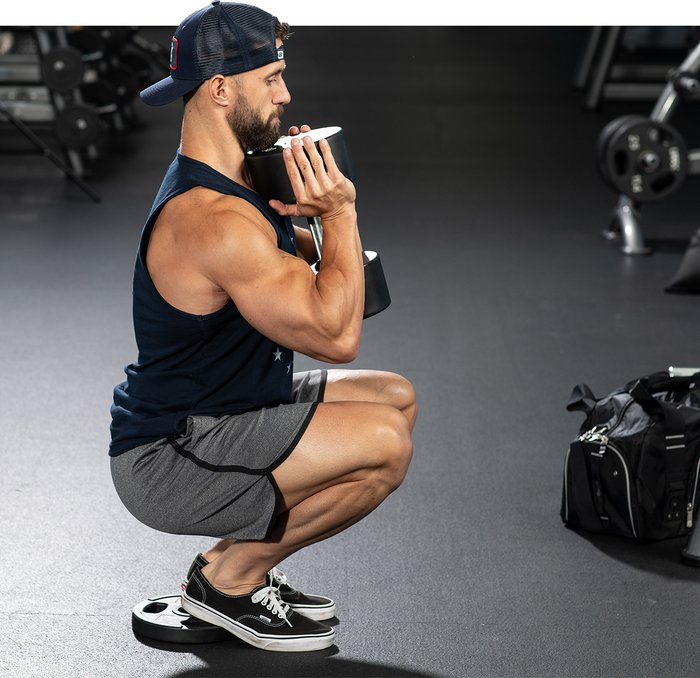
Heels-Elevated Dumbbell Goblet Squat
"A lot of people who do front barbell squats have a hard time stimulating their quad muscles," Smith says. "They tend to support the weight on shoulder muscles that are a lot smaller than their quads, so it limits how much weight they can handle."
Smith addresses that situation by swapping out the barbell for a dumbbell, and upping the reps to where few people brave to go with barbell front squats.
What's more, he recommends performing this squat variation with your heels—and only your heels—touching, and elevated about the width of a plate. Point your knees out as you would in a normal squat stance. Keep the weight pressed against your chest, keep the lowering half of the rep slow, and you'll definitely feel it in your quads.
"This variation is basically a front squat because this also keeps the weight centered close to your body as it would be if you were doing a normal front barbell squat," Smith explains.
Sets and reps: 4 sets of 20, 15, 10, 10 reps

2. Good Morning Into a Squat

Good mornings and squats are both great exercises on their own. So why do them together? For one, it'll help you hit every part of your legs without having to use a heavy weight. You'll feel your hams and glutes getting stretched to the max on the good morning, and then they and your quads will power you through the squats. It'll also allow you to maximize the precious time you have in the squat rack, if you were planning on doing squats first and then a hamstring-focused movement like RDLs or stiff-legged deads afterward.
A good morning is very difficult to do with a lot of weight on the bar, so you want to use 20-25 percent of your normal squat weight. You may be able to squat 315 pounds for 8 reps, but you're not going to be able to carry that much in a good morning.
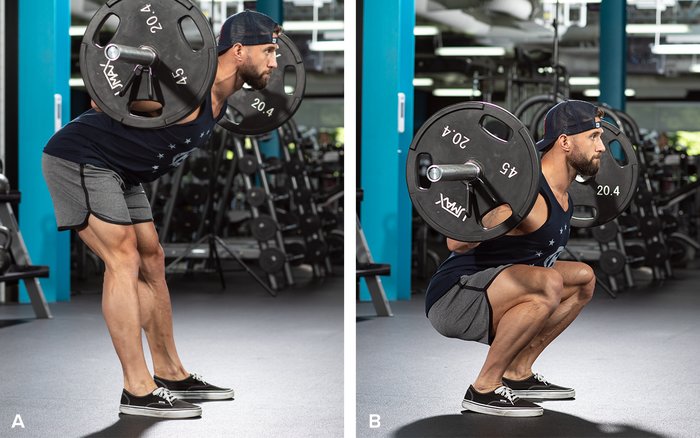
Good Morning Into a Squat
To be clear, you're not doing a full rep of a good morning followed by a full rep of a squat. You'll bend forward into the good morning, then drop your butt down into the bottom of a squat. For your back's sake, you'll definitely want to position your feet wider than you would for a good morning.
Sets and reps: 4 sets of 12, 10, 8, 8 reps

3. Seated Cable Row Wide-Grip Lat Pull-down

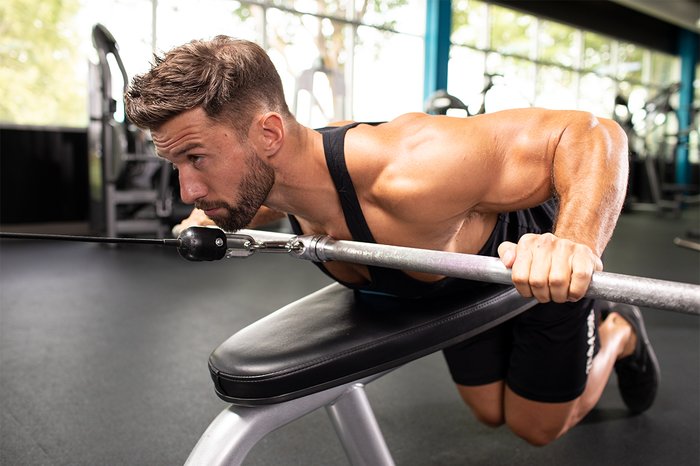
If you're working out in a crowded gym and the lat pull-down machines are taken, your back day doesn't have to come to a grinding halt. Just find an open seated cable row machine and do your pull-downs while lying facedown on the cable row bench.
Seated Cable Row Wide-Grip Lat Pull-down
"What I like more than anything about this variation," Smith says, "is that since you're lying down on your stomach and your chest is flat on the pad, you can take a lot of the torso momentum out of this movement, which helps you give your lats a better workout."
Sets and reps: 4 sets of 10 reps

4. Bodyweight Leg Extension

This is another perfect variation for a day at the gym when everyone seems to be on the same split as you.
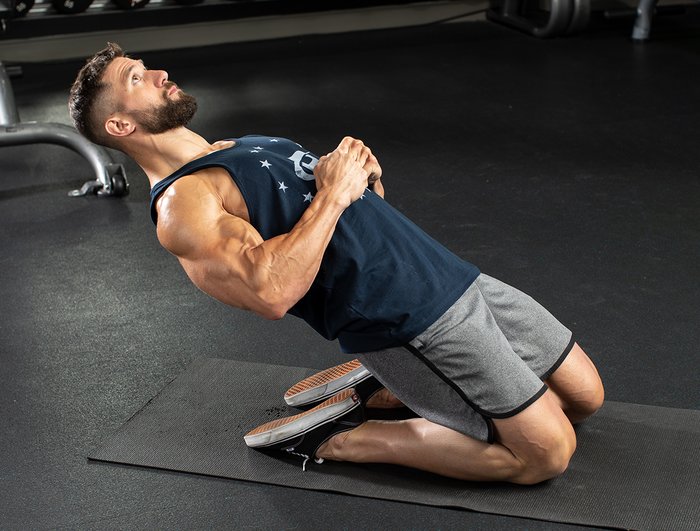
"Bodyweight leg extensions are basically the exact same movement as a leg extension," Smith says, "but you can do them without a leg extension machine just by using the floor and your body weight."
Bodyweight Leg Extension
Kneel on the floor with your legs straight out behind you and your upper body erect. Keeping your back straight, lean back, lowering your butt down to your heels, then bring yourself back up again. That's it. But, like anyone who has tried Smith's popular take on the sissy squat can attest, your quads will burn like a raging inferno for days afterward.
Sets and reps: 4 sets to failure

5. Wrestler's Bridge

Wrestling bridges used to be a staple of strength training, but you don't see them much anymore. But if you're simply doing shrugs in the hopes that it'll give you that "strong like a bull" look, this may be just what you need. (Keep doing those shrugs too, though.)
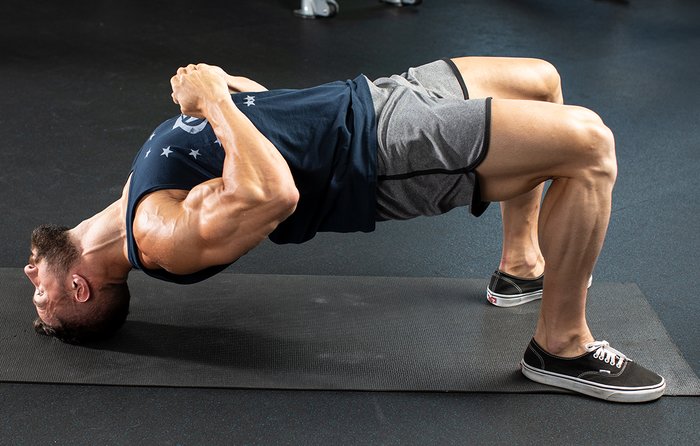
"A lot of people think this is a pretty barbaric exercise, but it's an old-school move," says Smith. "Not a lot of people want to lie on their back and lift their entire torso off the ground by their head and neck support, but it's actually a very safe exercise. A lot of people do it for wrestling and MMA-style training."
Wrestlers Bridge
The best part? All you need is a bit of floor space and a towel or pad for your head. Train these along with shoulders and traps, and get ready to stretch that neck hole.
Sets and reps: 4 sets to failure

Most Powerfull

  How to get rid of muscle cramps in your legs     The muscles in your legs are made up of bundles of fibers that alternately contract and ...